The National Psychology Exam, explained
Last updated 3 October 2026
If you are a provisional psychologist on the 5+1 or 4+2 pathway, you must pass the National Psychology Exam before you can apply for general registration. It is a regulatory exam, not a university one. The Board describes it as “based on actual case studies and professional issues likely to be faced by psychologists working with the public”, and it tests the threshold competencies for practising on your own. This page sets out what it is, when you sit it, what it covers, and how to prepare, with the Board's own documents linked so you can check anything here against the source.
The format, at a glance
- 150 multiple-choice questions. Most are a short case, a lead-in question and five options, of which one is “the best or most correct option” in the Board's view and four are wrong.
- Four domains. 45 questions on ethics, 45 on assessment, 45 on intervention and 15 on communication.
- 3.5 hours (210 minutes) for the exam itself. The Board asks you to allow four hours in all, so there is time for registration beforehand and the post-exam procedures after.
- A scaled passing score of 70 per cent. Your raw mark out of 150 is converted to a 0 to 100 scale, so that candidates in a harder exam period are not disadvantaged. You are told pass or fail, not your score.
- No deduction for wrong answers. Every question is worth the same, and the Board encourages you to attempt all 150.
- Results by email within four to six weeks of the close of the exam period. A candidate who fails must re-sit the whole exam.
- Online, or at a test centre. You choose between online proctoring and a test centre when you book. The fee is on the Board's schedule of fees.
When you sit it
The Board's exam guidelines say a 5+1 provisional psychologist is eligible “during the sixth year”, which is the internship year itself, and a 4+2 provisional psychologist during the sixth year, “after 1,500 hours of supervised practice internship”. In practice that means the exam runs alongside your logbook hours, not after them, and your final assessment of competence is completed after you have passed. Most people choose a sitting a few months before they expect to finish their hours, so a re-sit would not hold up registration. Exam periods and booking dates are published on the Board's National Psychology Exam page.
What it covers
The exam is written to the Board's National Psychology Exam curriculum, which took effect on 1 December 2025, and draws on the Board's recommended readings. The four domains:
- Ethics. Applying the Board's Code of conduct for psychologists (in force from 1 December 2025) to case studies with ethical dilemmas, together with the National Law, mandatory notifications, privacy and record keeping, and the legal duties that bear on practice.
- Assessment. Interviewing and the mental status examination, risk assessment, psychometrics and test selection, and the tests themselves: the curriculum names six core tests you must be able to administer, score and interpret (the DASS, K10, PAI, SDQ, WAIS and WISC) and 22 more you must know the use and purpose of.
- Intervention. Evidence-based interventions for the disorders on the curriculum, the main therapy models, the therapeutic alliance, and what the APS evidence review supports for each presentation.
- Communication. Reports and referral letters, feedback to clients and others, explaining your role, working with other professionals, and communicating across cultures and by telehealth.
How to prepare
The candidate manual is plain about it: “the responsibility to prepare for and pass the exam rests with the candidate”. The Board points you to the curriculum, its recommended readings, and the sample questions it publishes. From what provisional psychologists tell us, four things make the difference:
- Start early in the internship, not the month before. The curriculum is wide, and the reading list is long. An hour or two a week from the start does more than a month of cramming at the end.
- Learn the Code of conduct properly. The December 2025 Code replaced the APS Code for registration purposes, and 30 per cent of the exam is applying it to cases.
- Know the six core tests thoroughly. Scoring, cut-offs, age ranges, what each index measures. These questions have one right answer, and no amount of reasoning in the exam room will supply it.
- Practise on case questions, and read the reasoning. The exam asks for the most appropriate response, and the skill is telling a good option from the best one. That only comes from working through cases and seeing why each wrong option is wrong.
How PsychLog prepares you for it
NPE prep sits inside PsychLog, next to your logbook, and is built from the curriculum and the Board's reading list rather than from a course outline. It has study pages for every topic, quick drills, practice questions, mock exams, a study plan that tracks your progress by domain, and a library of the source documents it draws on.
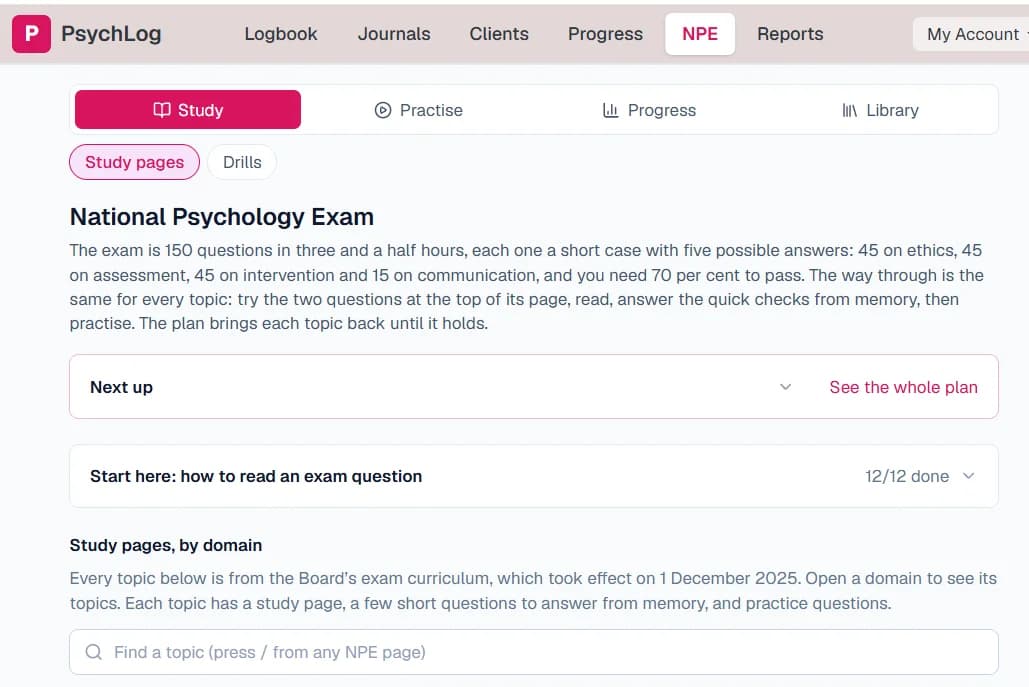
- A study page for every topic on the curriculum. Each one opens with the essentials, then a worked case, then the detail, with diagrams where they help. The facts carry numbered sources you can open, with the quote behind each one.
- A starting check and a plan. Answer 20, 40 or 60 questions, untimed, with an “I don't know yet” option so that a guess is not counted as knowledge. The plan then orders the topics for the weeks you have left and the hours a week you can give, and brings each topic back until it holds.
- Practice questions with the reasoning. More than 900 case-based questions written the way the exam writes them: a case, a lead-in question and five options. After each one you see why the correct answer is the best one and why each other option is not, with the source behind it.
- Mock exams at the exam's pace. 20, 50, 100 or the full 150 questions, timed or untimed, with the domains in the exam's proportions and your results by domain.
- Quick drills. Match a test to what it measures, sort subtests into their indexes, read which band a score falls in, or put a method's steps in order. Each takes a few minutes.
- Exam technique first. Twelve short pages on how a question is put together and how to read it, to work through before you start on the content.
NPE prep is included with every PsychLog subscription taken out by 31 October 2026, and free-trial accounts can use it too. Start your free trial — 14 days free, no credit card.
Common questions
How many questions are in the National Psychology Exam, and how long is it?
150 multiple-choice questions in 3.5 hours (210 minutes): 45 on ethics, 45 on assessment, 45 on intervention and 15 on communication. Each question is usually a short case, a lead-in question and five options.
What is the pass mark for the NPE?
A scaled score of 70 per cent. Raw marks are converted to a scale so that every exam period is held to the same standard. Results are pass or fail, by email, within four to six weeks of the end of the exam period.
When can a 5+1 provisional psychologist sit the exam?
During the sixth year, which for the 5+1 is the internship year. A 4+2 provisional psychologist is eligible during the sixth year, after 1,500 hours of supervised practice.
Are marks deducted for wrong answers?
No. Every question is worth the same and nothing is taken off for a wrong answer, so the Board encourages candidates to attempt every question.
The Board's documents
Everything above is drawn from the Board's National Psychology Exam page, where the candidate manual, the exam guidelines, the curriculum, the recommended readings and the sample questions are published. Those documents are the authority; if anything here and the Board disagree, the Board is right and we would like to know.